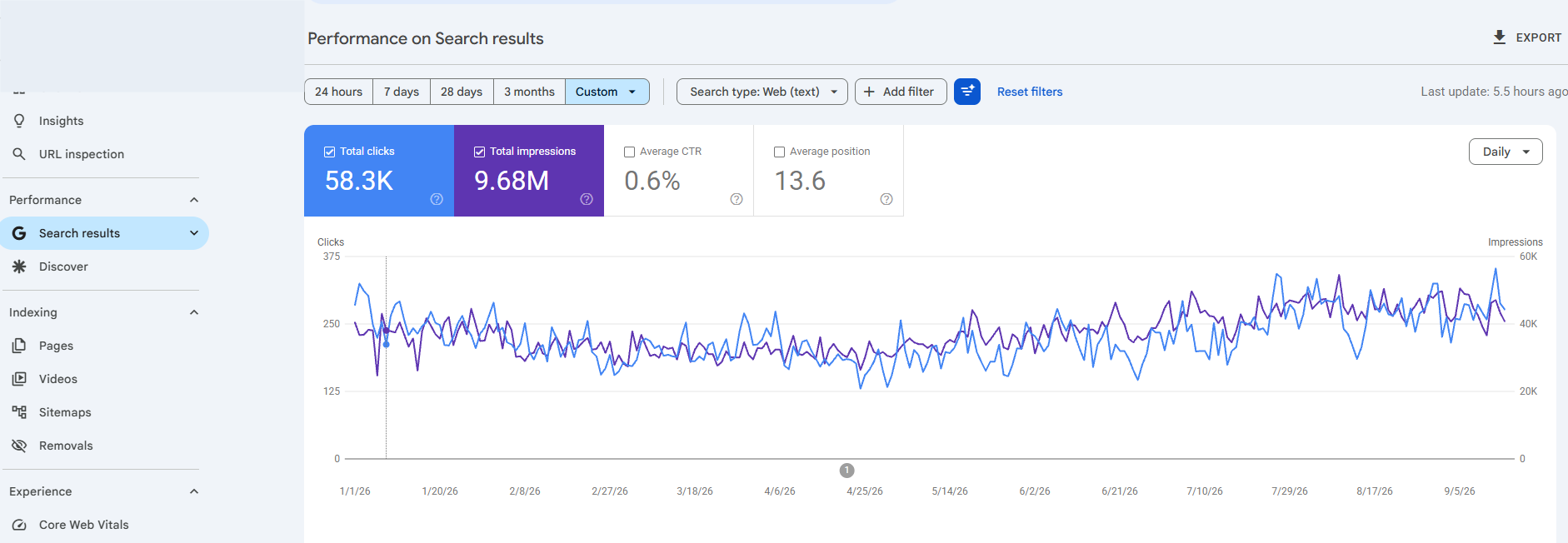
Google Search Console showed 58.3K organic clicks, 9.68M search impressions, and an average position of 13.6 across the measured period.
- Client type
- UK Sofa Ecommerce Brand
- Channel
- E-commerce SEO
An ecommerce SEO case study for a UK sofa brand that reached 58.3K organic clicks and 9.68M search impressions through commercial content, internal linking, and technical SEO.
Google Search Console showed 58.3K organic clicks, 9.68M search impressions, and an average position of 13.6 across the measured period.
The brand needed organic search to support high-intent furniture buyers across competitive sofa and collection-level searches.
Commercial terms, content gaps, internal linking, and technical SEO were tightened around the way buyers searched for sofas online.
Google Search Console showed 58.3K organic clicks, 9.68M search impressions, and an average position of 13.6 across the measured period.

A practical view of the workstreams behind the result, before the long-form story expands on the details.
We reviewed where uk sofa ecommerce brand growth was stalling across visibility, content depth, technical health, conversion paths, and measurement.
The E-commerce SEO work was ordered around the changes most likely to influence qualified demand, not around a generic checklist.
Commercial terms, content gaps, internal linking, and technical SEO were tightened around the way buyers searched for sofas online.
Google Search Console showed 58.3K organic clicks, 9.68M search impressions, and an average position of 13.6 across the measured period.
A UK sofa ecommerce brand competing in a crowded furniture category where buyers compare styles, materials, delivery options, price points, and trust signals before purchasing. Client details are anonymized to protect confidentiality.
The site needed to turn organic search into a dependable acquisition channel for commercial sofa queries, not just informational furniture traffic. The market was competitive, and category pages had to carry more of the buying journey.
The work focused on ecommerce SEO for high-value furniture searches:
Furniture ecommerce SEO works when product and category architecture match the way buyers compare options. The site did not need more generic blog content first; it needed commercial pages, supporting content, and internal links to work together around search demand.
For similar ecommerce work, see SEO for Ecommerce and SEO.

We thought the issue was just traffic. HGM showed us that our product pages were not explaining the offer clearly enough. The changes were practical, the reporting was easy to follow, and the enquiries we got afterwards were a better fit.
Ecommerce business owner · Online retail brand
The brand needed organic search to support high-intent furniture buyers across competitive sofa and collection-level searches.
Commercial terms, content gaps, internal linking, and technical SEO were tightened around the way buyers searched for sofas online.
No. This case study shows what changed in one context. Results depend on the starting website, market, competition, tracking, offer quality, implementation speed, and the buyer journey.
It can be useful as a pattern, but the right plan still depends on the specific market, service mix, proof assets, conversion path, and growth constraint for each business.
Anonymised client feedback from businesses that needed clearer priorities, sharper pages, and work tied to actual enquiries.
We thought the issue was just traffic. HGM showed us that our product pages were not explaining the offer clearly enough. The changes were practical, the reporting was easy to follow, and the enquiries we got afterwards were a better fit.
We had a long list of SEO tasks and no idea what mattered first. HGM helped us sort the technical issues from the things that were actually stopping people from contacting us. It felt much more useful than another generic audit.
Our services made sense to us internally, but they were confusing on the website. HGM helped us split the pages properly, rewrite the vague sections, and make the next step clearer for visitors. The site finally felt easier to explain.
They did not try to rewrite everything for the sake of it. They pointed out where buyers were likely getting stuck, tightened the calls to action, and made the page feel more trustworthy without making it sound like a sales script.
We had separate people looking at content, tracking, and the website, but no one was joining it up. HGM looked at the whole path and gave us a clear order of fixes. The conversations from the site became easier to qualify.
The most useful part was the directness. We did not need a long presentation full of charts; we needed to know why the pages were not converting and what to fix first. That is what we got.
Book a free consultation and we'll map the constraints, channels, and fixes most likely to create measurable progress.