Who Was the Client?
The client was a specialist B2B distributor with a large WooCommerce (a WordPress e-commerce plugin used to run product catalogues and online stores) catalogue, technical product data, and long buying cycles. Client details are anonymized to protect confidentiality.
What Was the Challenge?
The website contained useful product and category information, but the structure did not expose that depth clearly. Important product families were buried, metadata was inconsistent, and internal links did not reflect how engineers and buyers searched.
What Was the Strategy?
We audited category architecture, product templates, crawl depth (how many clicks a search engine needs to reach a page from the homepage), indexation, faceted URLs (filter-generated pages, such as by size or brand, that can create excess duplicate URLs), internal links, and commercial keyword coverage. Recommendations focused on making the catalogue easier to crawl, easier to evaluate, and easier to connect to technical buyer intent.
What Were the Results?
- Priority product families surfaced
- WooCommerce category structure cleaned up
- Internal linking rules created for related products
- Technical metadata and schema opportunities mapped
- Low-value crawl paths separated from commercial pages
What Was the Measured Impact?
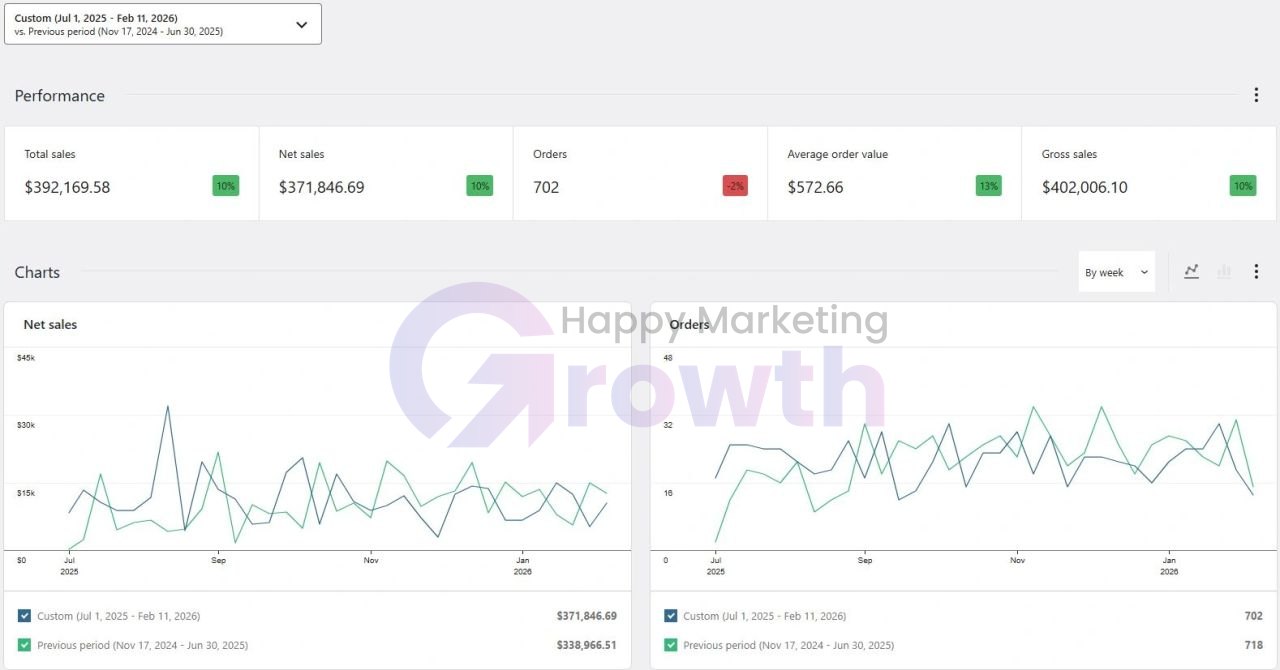
- Net sales up 10%, from $338,967 to $371,847
- Average order value up 13%, to $572.66
- Gross sales of $402,006 in the period
- 702 orders, against 718 in the previous period (down 2%)
Why Did This Work?
B2B catalogue SEO depends on structure. Search engines need to understand not only the products, but how product families, specifications, applications, and buyer intent connect.
The store took slightly fewer orders than in the previous period, but each order was worth more, so revenue still grew. That pattern fits a catalogue that is easier for serious B2B buyers to find and evaluate. The figures are total store sales across all channels, not organic search alone.
For similar technical cleanup, start with Technical SEO or Ecommerce SEO. Market-specific support is also available through Technical SEO Services in Dubai and Technical SEO Services in UAE.