Who Was the Client?
A founder-led professional services brand (client details are anonymized to protect confidentiality) that needed clearer representation across branded Google results, third-party profiles, and AI answer systems (tools like ChatGPT, Gemini, and Google's AI Overviews that answer search queries directly rather than just listing links).
What Was the Challenge?
The website explained the company well, but the wider evidence ecosystem was messy. Older profiles used inconsistent descriptions, some third-party pages connected the founder to the wrong context, and AI systems sometimes surfaced dated or incomplete sources when asked about the brand.
Basic SEO activity would not solve the problem on its own. The issue was not a shortage of blog posts or backlinks. The brand needed a clear source hierarchy, stronger third-party corroboration, and a repeatable way to measure whether search and answer systems were becoming more accurate.
What Was the Strategy?
We built a forensic entity map covering the founder, company, services, locations, public profiles, media mentions, and high-visibility third-party sources. Each source was scored by relevance, accuracy, authority, visibility, and whether it reinforced or conflicted with the desired brand narrative.
The action plan separated work into three streams: first-party clarity on the website, external profile and citation corrections, and authority-building assets that independent sources could reference. Instead of chasing volume, the roadmap prioritized the sources most likely to influence branded search results and AI retrieval.
What Were the Results?
- Founder, company, service, and profile relationships mapped
- High-value third-party sources separated from low-impact mentions
- Outdated profiles and conflicting descriptions prioritized for correction
- Digital PR (earned media and press coverage that builds independent, third-party proof) and content assignments tied to specific evidence gaps
- Fixed query panel created for before-and-after AI/search checks
Impact Metrics
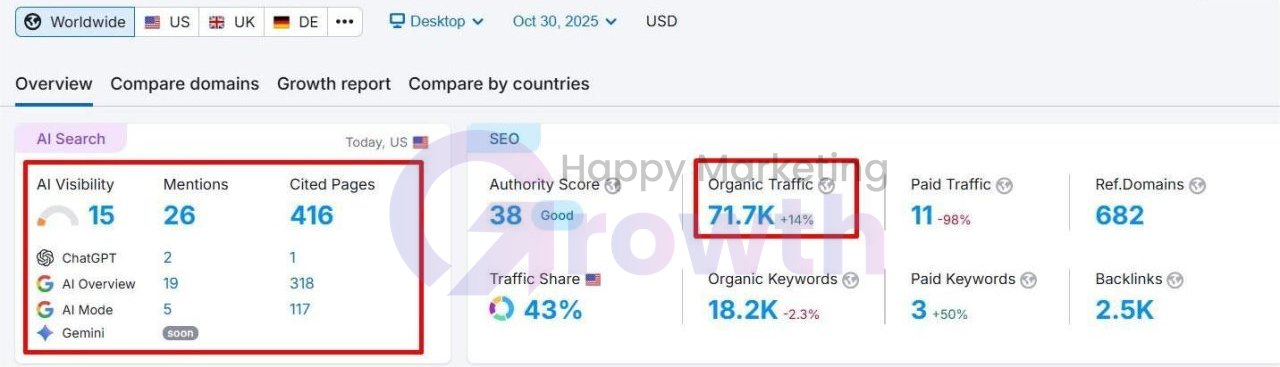
- 416 pages cited in AI answers: 318 in Google AI Overviews, 117 in Google AI Mode, and 1 in ChatGPT (some pages are cited on more than one)
- 26 AI mentions of the brand, and an AI Visibility score of 15 in Semrush
- 71,700 estimated monthly organic visits, from 18,200 ranking keywords
- 682 referring domains and an Authority Score of 38
Traffic figures are Semrush estimates, not the site's own analytics.
Why Did This Work?
AI search visibility depends on more than publishing more pages. When search systems and answer engines see the same entity relationships repeated across strong, relevant sources, the brand becomes easier to understand, cite, and recommend.