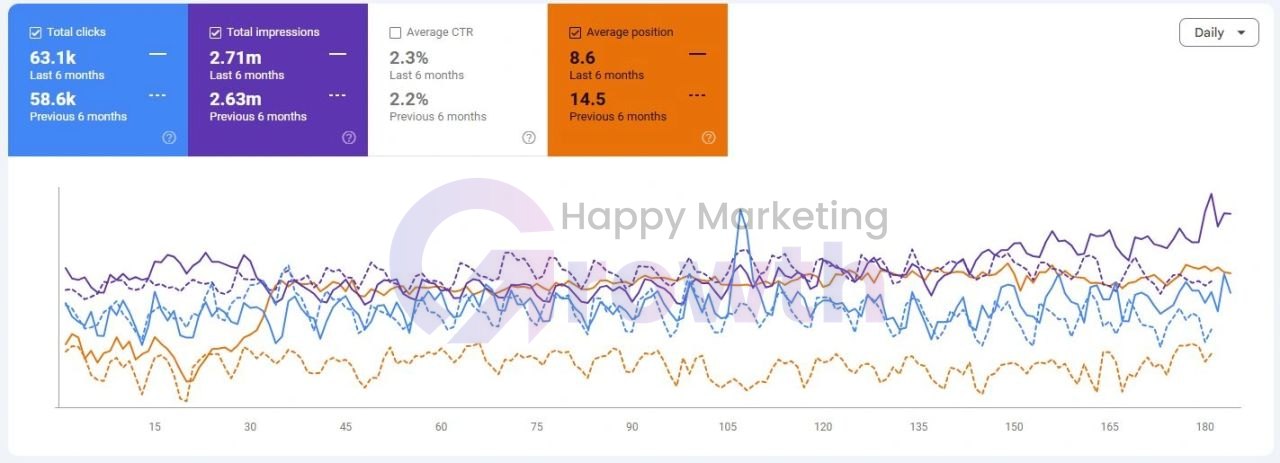
Average Google position improved from 14.5 to 8.6 against the previous six months, with clicks up from 58,600 to 63,100 and impressions from 2.63M to 2.71M.
- Client type
- Professional Services Firm
- Channel
- SEO
- Measured over
- 6 months vs the previous 6
A professional services SEO case study on moving an established firm's average Google position from 14.5 to 8.6 in six months, taking its typical ranking from page two onto page one.
Average Google position improved from 14.5 to 8.6 against the previous six months, with clicks up from 58,600 to 63,100 and impressions from 2.63M to 2.71M.
The site already had real search visibility, but its average ranking sat on page two, where few searchers click.
SEO work focused on moving the site's existing rankings up, not just adding more of them.
Average Google position improved from 14.5 to 8.6 against the previous six months, with clicks up from 58,600 to 63,100 and impressions from 2.63M to 2.71M.

A practical view of the workstreams behind the result, before the long-form story expands on the details.
We reviewed where professional services firm growth was stalling across visibility, content depth, technical health, conversion paths, and measurement.
The SEO work was ordered around the changes most likely to influence qualified demand, not around a generic checklist.
SEO work focused on moving the site's existing rankings up, not just adding more of them.
Average Google position improved from 14.5 to 8.6 against the previous six months, with clicks up from 58,600 to 63,100 and impressions from 2.63M to 2.71M.
An established professional services firm whose website already earned tens of thousands of search clicks. Client details are anonymized to protect confidentiality.
The site was visible in Google, but its average position was 14.5: most of its rankings sat on page two, where very few searchers click. More visibility alone would not fix that. The existing rankings needed to move up.
The SEO work concentrated on the pages and queries the site already ranked for, improving them so Google would place them higher instead of spreading effort across new, unproven topics.
Moving a ranking from page two to page one matters more than adding new rankings on page two. The site was shown a similar number of times, but in better positions, so more of those impressions became clicks.

HGM helped us turn a messy service offering into pages that customers could actually understand. The copy became sharper, the structure made more sense, and our team finally had a roadmap we could follow.
Ines Varma · Managing Partner, Growth Consultancy
The site already had real search visibility, but its average ranking sat on page two, where few searchers click.
SEO work focused on moving the site's existing rankings up, not just adding more of them.
No. This case study shows what changed in one context. Results depend on the starting website, market, competition, tracking, offer quality, implementation speed, and the buyer journey.
It can be useful as a pattern, but the right plan still depends on the specific market, service mix, proof assets, conversion path, and growth constraint for each business.
Book a free consultation and we'll map the constraints, channels, and fixes most likely to create measurable progress.